
Most IB Physics students take notes the wrong way. They copy out their textbook, re-write their class notes by hand in different colours, or highlight entire chapters. Hours of effort. Very little payoff.
The problem is not the note-taking itself. It is the absence of a system. Without a system, your notes are just a pile of information with no structure, no purpose, and no clear link to what the exam actually asks.
Your goal is not to write down everything. Your goal is to build a reference that makes doing past paper questions faster and more effective.
Here is exactly how to do it.
The Six-Section Revision Note Template
Every IB Physics topic should be condensed into the same structure, every time. Six sections, in this order:
- Formulae
- Key Definitions
- Common Diagrams
- Common Graphs
- Experiments
- Other Notes
When you use the same layout for every topic, you start to know instinctively where to look for information. You also start to notice gaps much earlier, because a blank section tells you immediately what you have not covered yet.
The template looks like this:
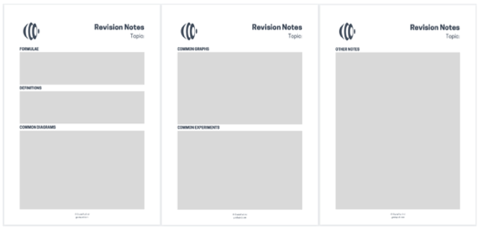
Print several blank copies of this template and you are ready to build your notes for every topic in the current IB Physics syllabus.
The GradePod Exam Pack includes a blank revision note template for every topic. Sally references it throughout her YouTube tutorials, so you know exactly what to add and when. The sections below will walk you through each one.
Section 1: Formulae
Open your learning objectives for the topic. Write down every formula you can see.
If you are completely confident with a formula and understand exactly how to use it, just write it down and move on. If you are less sure, add a short note next to it. An extra sentence of context now saves you from a confusing moment in the middle of a past paper later.
Here is an example from the Thermal Physics topic:
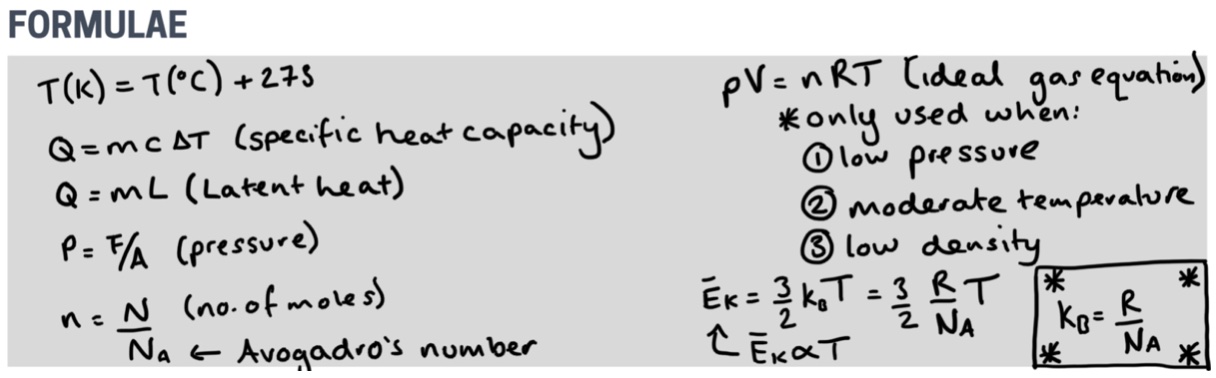
Notice what is happening here. Some formulas have no annotation at all. Others have a note, a condition, or a star.
The stars matter. You will be given the IB Physics data booklet in your exam. It contains most of the formulas you need, but not all of them. Any formula that does not appear in the data booklet needs a star in your notes, because you have to memorise it. The Boltzmann constant formula above is a good example: it is not in the booklet, so it needs to go in your head.
If you are unsure which formulas to memorise, read the IB Physics formulas to memorise post. It covers everything the exam expects you to know that is missing from the data booklet.
Section 2: Key Definitions
This section is worth far more marks than most students realise. Definitions and basic recall questions account for around 10% of your final exam mark. Ten percent. A handful of well-worded definitions, written down once and reviewed a few times, can genuinely move your grade.
The key word is “well-worded”. Vague paraphrases consistently lose marks. The examiner expects precise language. So when you write a definition in this section, write it in the exact form the mark scheme would accept.
Here is an example from Thermal Physics:
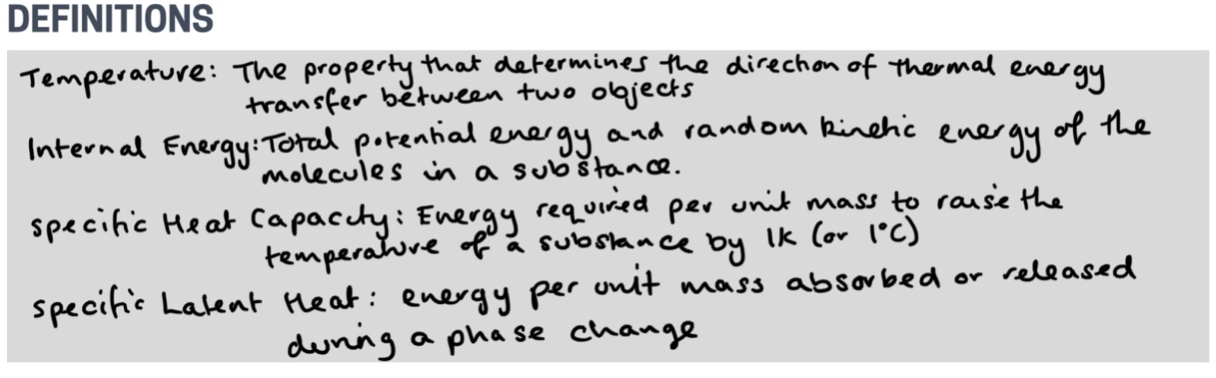
To know which definitions you need to include, look through your learning objectives for words like “define”, “state”, or “recall”. Those are the ones the IB will explicitly test. Once you have written them all, go back and mark the ones you need to memorise with a red star, the same as in the formulae section.
Section 3: Common Diagrams
Open your textbook or class notes at the correct chapter and copy the diagrams that appear in your learning objectives into this section. Then annotate them.
Annotating is the important part. A diagram with no labels or notes is just a picture. A diagram with questions asked and answered is a revision tool.
Use these prompts as you annotate:
- What scale is the diagram? (nanometres, metres, light years?)
- Are any parts of it moving?
- Have you labelled every component?
- Are there formulas associated with this diagram?
- Are there any key phrases or definitions linked to it?
Here is an example from Thermal Physics, showing the states of matter and a heating curve:
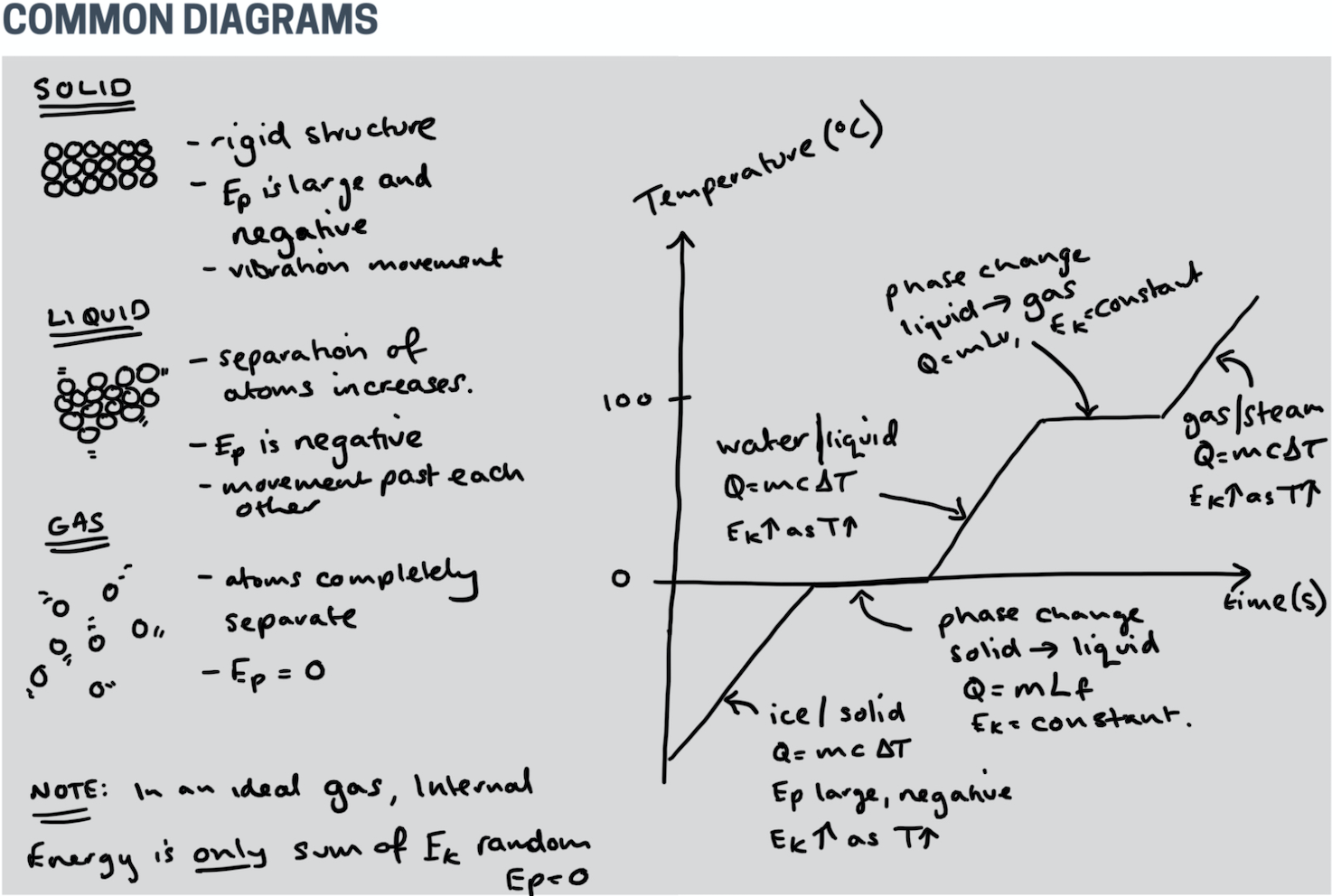
The left diagram is copied from the textbook. The right diagram has been annotated with the relevant equations and explanations. Both types are useful. Annotated diagrams do more work in the revision phase because they bring multiple pieces of information together in one place.
Section 4: Common Graphs
Follow exactly the same approach as diagrams. Look through your learning objectives, identify the graphs referenced there, and copy them into this section with full annotations.
Once you have the graphs sketched, push yourself to go further. Ask yourself:
- What is the mathematical relationship between the two variables? (directly proportional, inversely proportional, exponential?)
- What does the gradient represent?
- Is the gradient constant or varying? Why?
- What does the intercept represent?
- What does the area under the graph represent?
- Are there any limits to the graph? Does it extend to infinity?
Here is an example from Thermal Physics, covering the three gas laws:
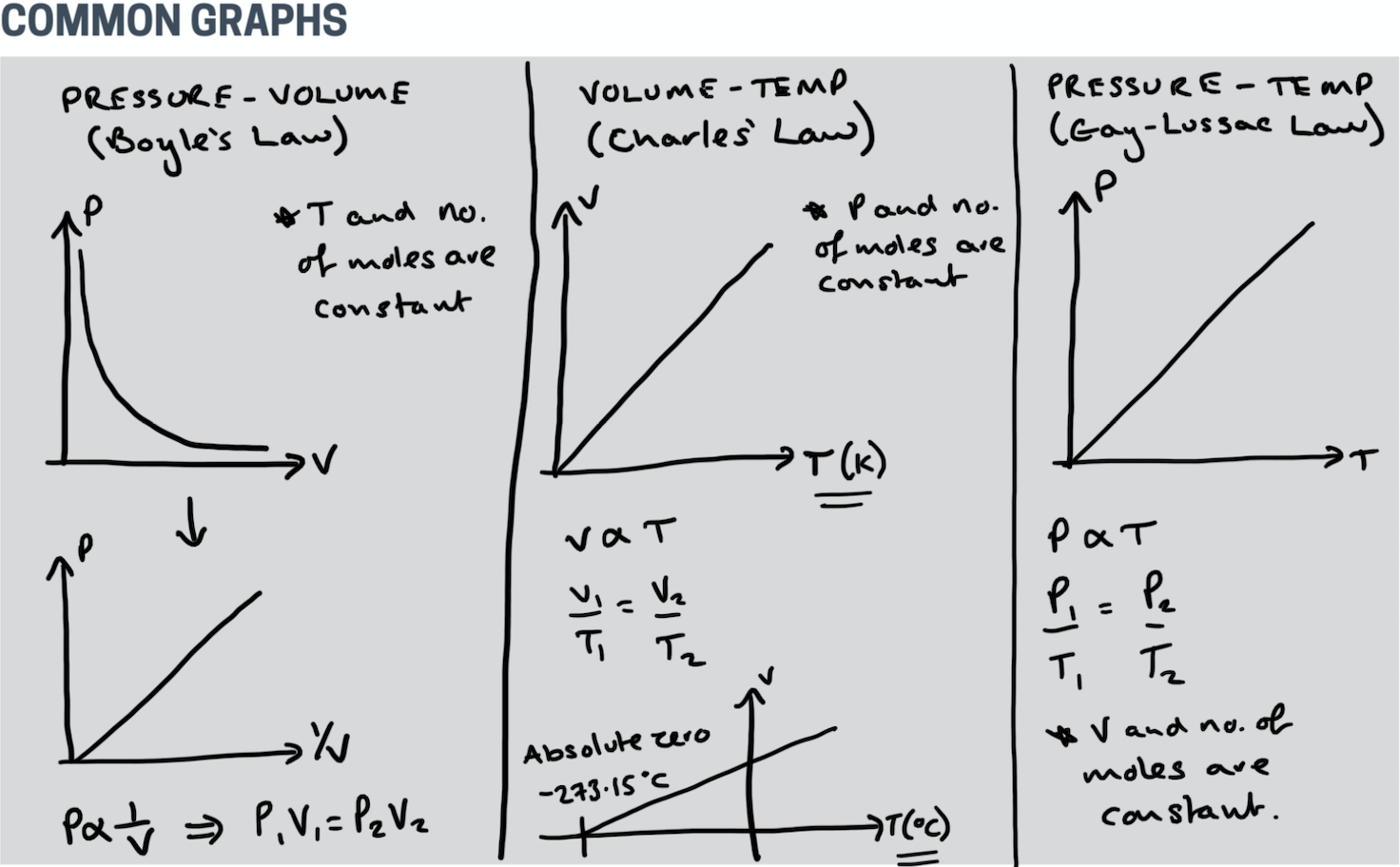
Annotated graphs are especially useful in Paper 2 extended response questions. When you are asked to explain a relationship or describe what a graph would look like under certain conditions, having already sketched and labelled these graphs means the answer comes to you much faster.
Section 5: Experiments
The IB Physics syllabus specifies a number of practical experiments you should carry out during the course. This section is where you summarise them.
Do not worry if you have not done all of these in class yet. They will be summarised in your textbook. Your job is to identify the experiments relevant to your topic and capture them concisely here. Use these prompts:
- What is the title of the experiment?
- What are the independent, dependent, and control variables?
- A brief sketch of the apparatus
- Two-sentence method maximum
- What table did you use to collect data?
- What did the graph of independent versus dependent variable look like?
- What conclusion did you draw?
- Where did errors occur? Were they random or systematic?
Here is an example from Thermal Physics, covering Specific Heat Capacity and Boyle’s Law:
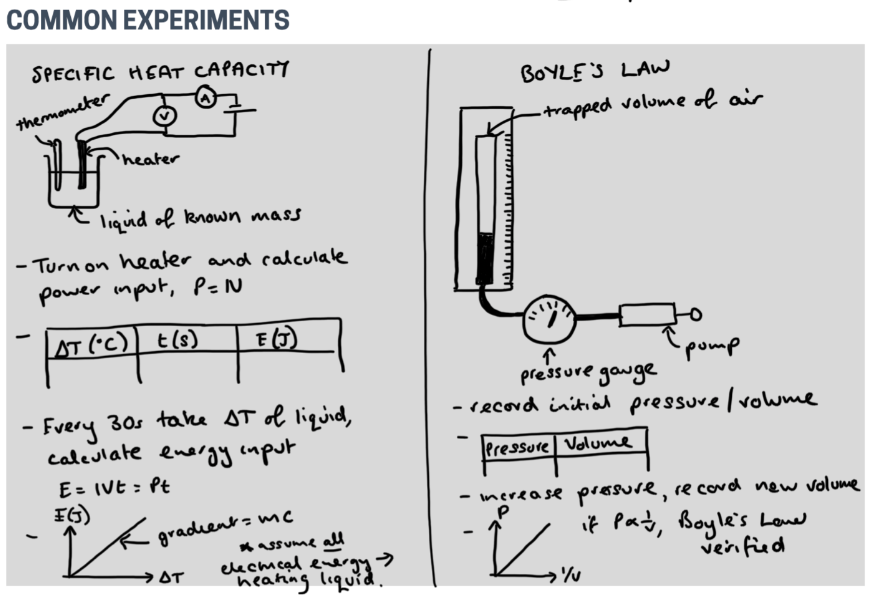
Keep this section concise. You do not need a full write-up. A quick sketch, a bullet-point method, and a rough graph shape is enough. The goal is recognition and recall, not a complete lab report.
Section 6: Other Notes
This is where everything else goes. Specifically, any learning objective that was not covered by the previous five sections.
It is also where you capture insights from doing past papers. When you work through exam questions and lose marks, write down what went wrong here. A short note after each past paper session builds up a personalised list of the things to watch out for in the exam.
Here is an example from Thermal Physics:
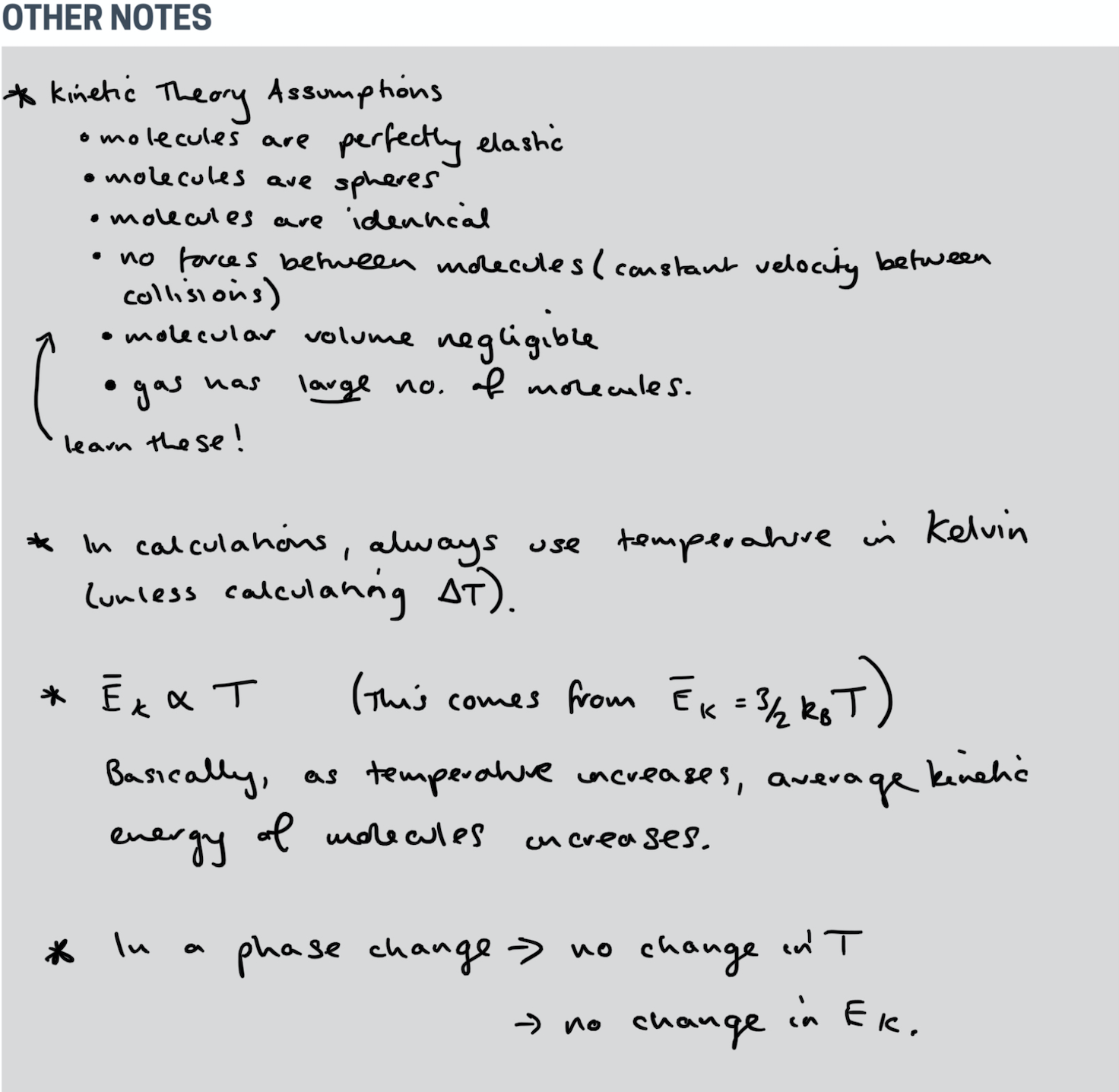
Notice the structure. Some notes are background knowledge (the kinetic theory assumptions). Some are practical reminders (always use Kelvin). Some are conceptual links (what happens to kinetic energy during a phase change). All of them are the kind of thing that comes up in exams and is easy to forget without a specific note.
What Finished Notes Look Like
When you have completed all six sections for a topic, you end up with two or three sides of A4 that contain everything the IB is likely to ask you about it.
Here is the full three-page set for Thermal Physics:
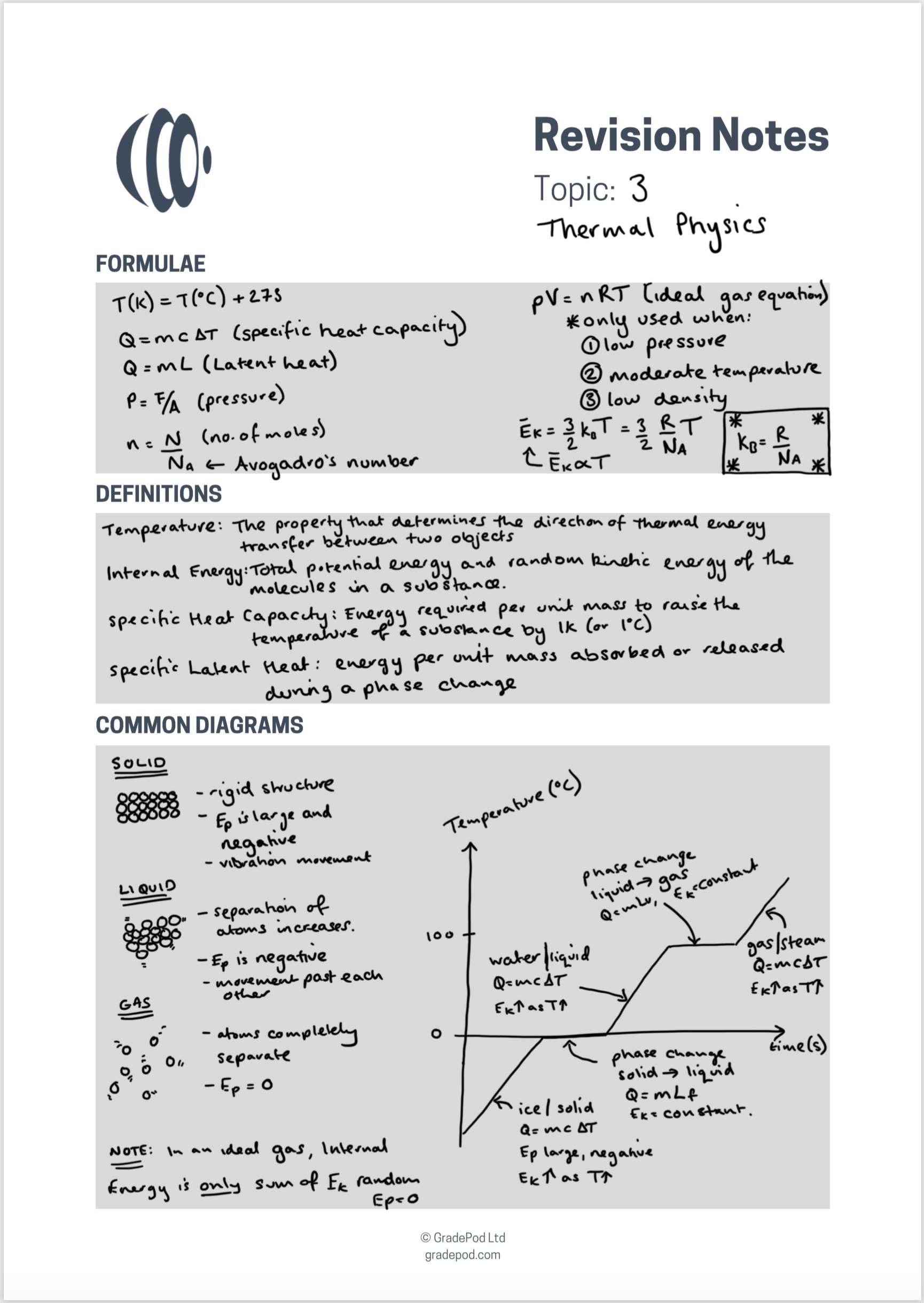
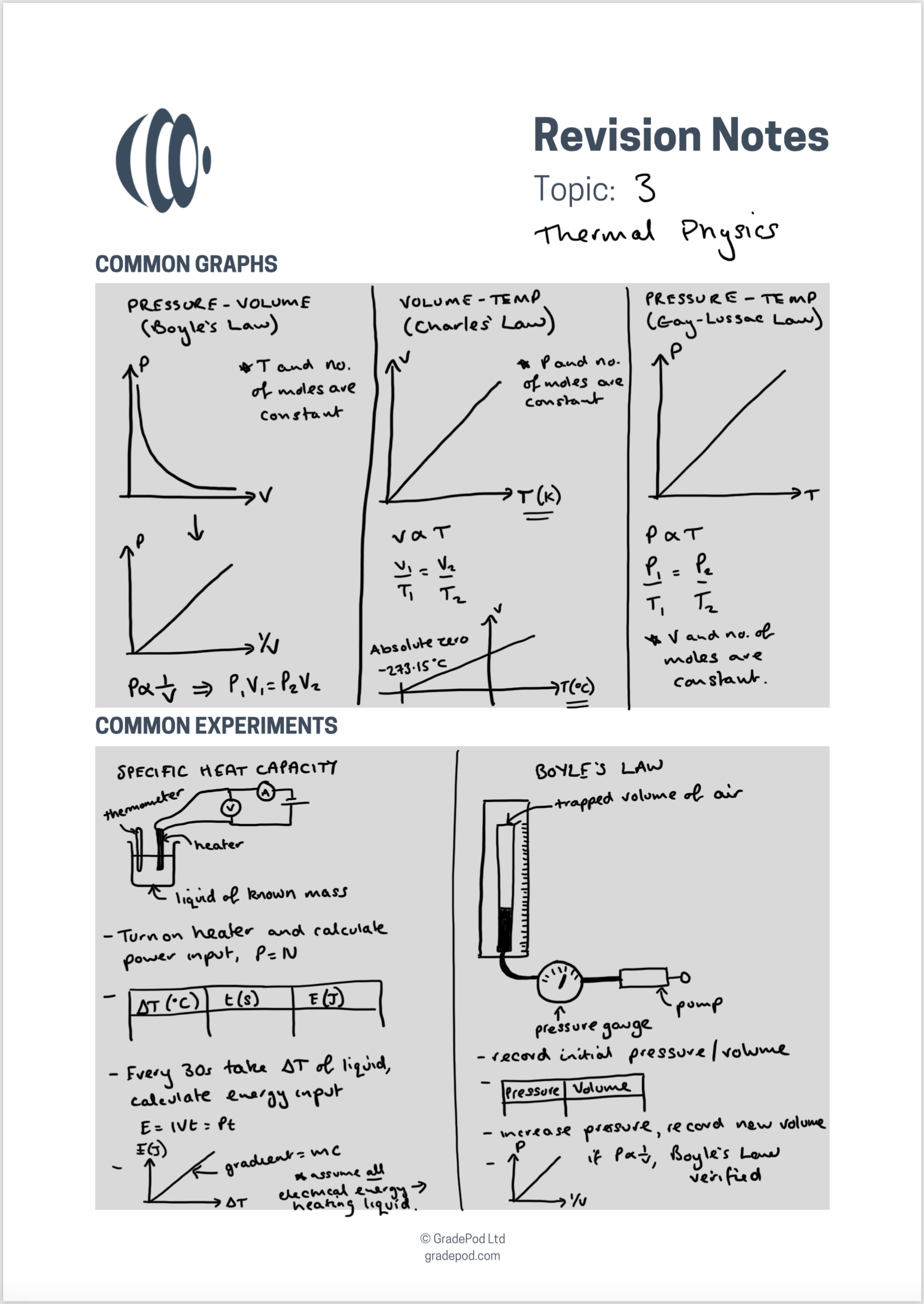
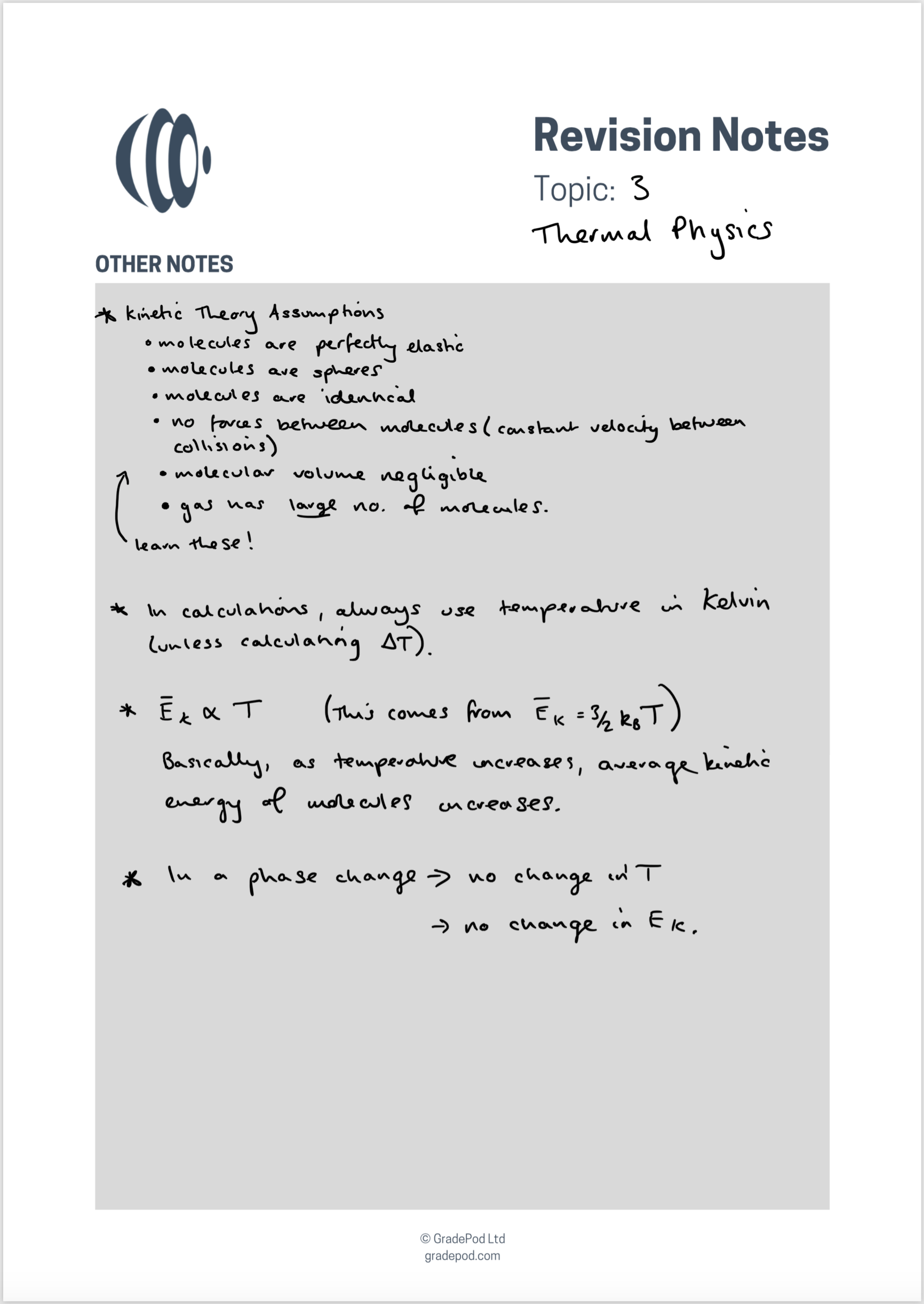
Two to three sides. Everything you need for that topic. The entire IB Physics syllabus in 24 sets of notes, each one in the same format.
A Note on How to Use These Notes
Writing the notes is step two in the process, not the whole strategy.
Once you have a set of notes for a topic, the next step is to use them as a reference while you work through past paper questions on that topic. You are not revising from the notes; you are practising exam technique with them nearby. When you look something up in your notes mid-question, you are reinforcing it. When you get a question wrong, you update your notes with what you learned.
That process is what converts understanding into exam marks. Your notes are a tool for that process, not a revision activity in themselves.
To see where note-taking fits in the wider study system, read the how to study IB Physics guide.
Get the GradePod Exam Pack for £39 →
Sally Weatherly is a Fellow of the Institute of Physics, author of 4 IB Physics books (two hit #1 on Amazon), and has been teaching IB Physics since 2004. GradePod has helped 30,000+ students since 2020.